Blog
Writing on LLMs, inference optimization, research, and ideas.
Posts
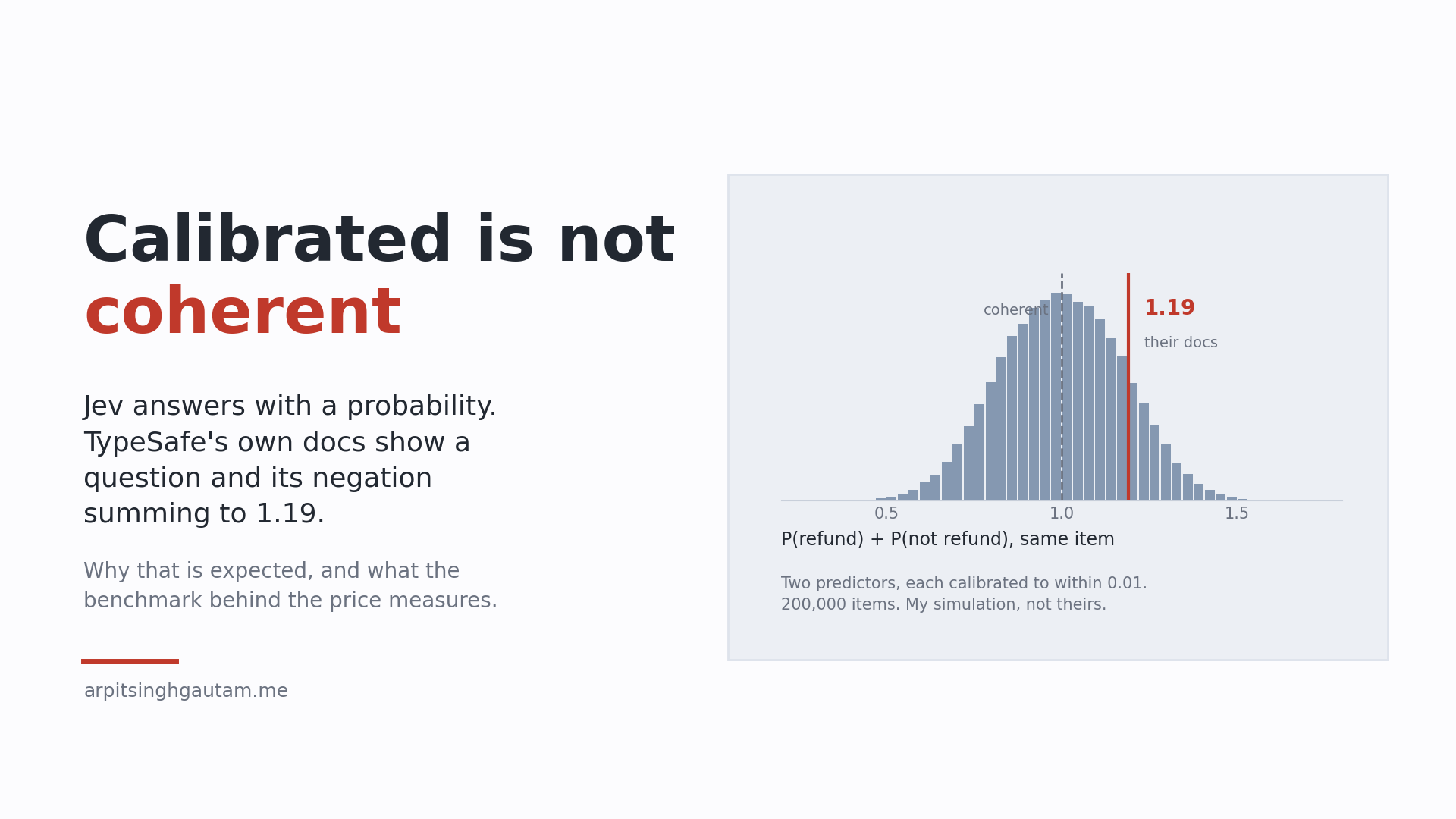
TypeSafe’s Jev returns a typed decision and a probability instead of text, bills nothing for output and answers in under half a second. Removing the decode phase explains every one of those numbers, and the price sheet divides back into the token counts the demos were measured at. The benchmark behind the headline multipliers grades Jev against the averaged answers of GPT-6 Astra and Claude Fable 5.1, which prices the decision and leaves the calibration claim untested. Their own docs then show a question and its negation summing to 1.19, and a short simulation shows why that is expected rather than broken.
Sep 2026 · 11 min read · Evaluation · Inference · Calibration
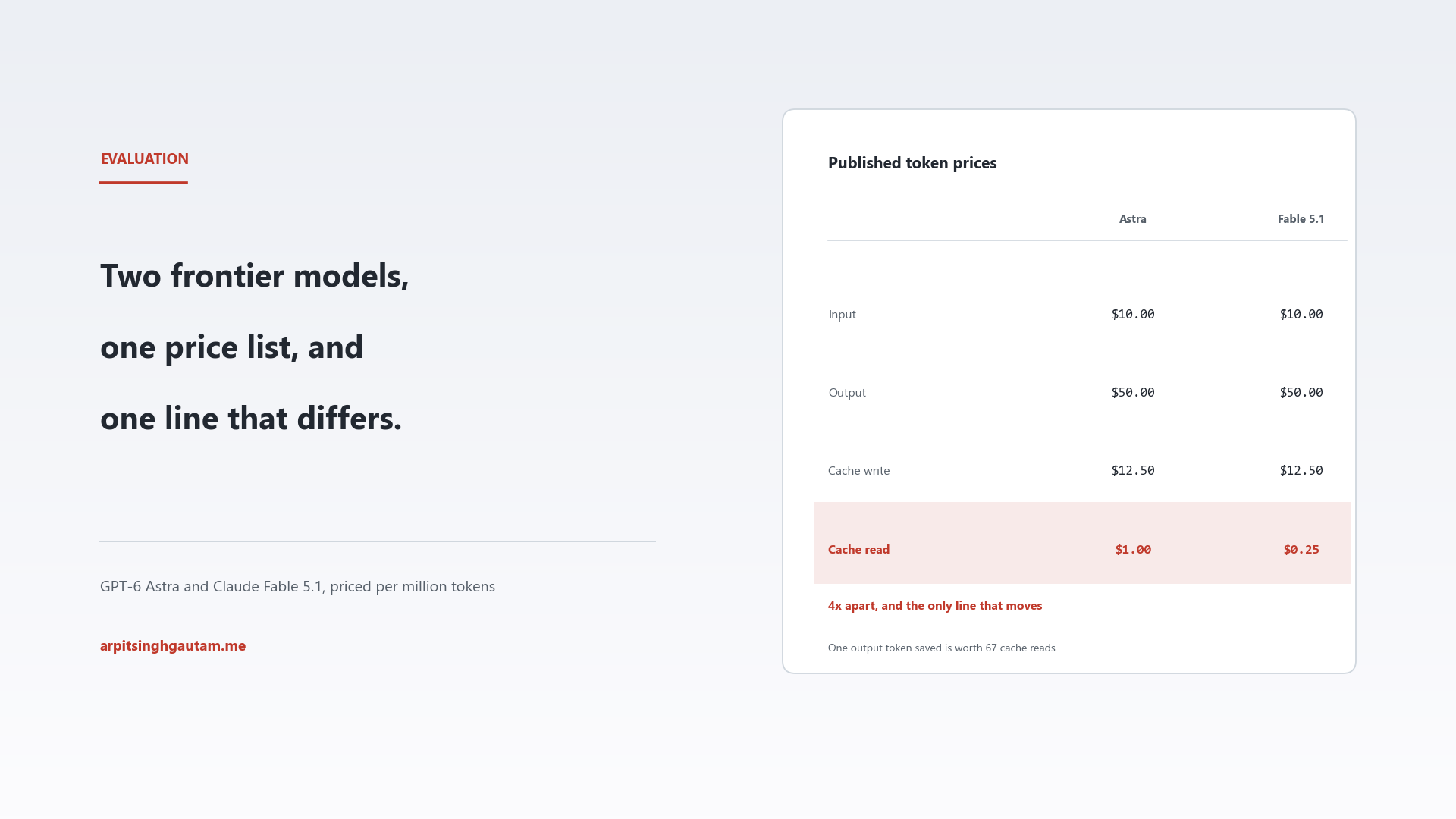
Claude Fable 5.1 and GPT-6 Astra charge the same for input, output and cache writes, and differ 4x on the one line nobody reads. Solving both labs’ competing cost claims gives an exchange rate of 67 cache-read tokens per output token, and recovers the token shape of the workloads Anthropic measured. The same announcement pages then show 55.8 and 60.9 percent on Terminal-Bench 4.0 from identical weights, under a footnote admitting some cells were finished by a different model.
Sep 2026 · 10 min read · Evaluation · Pricing · Agents
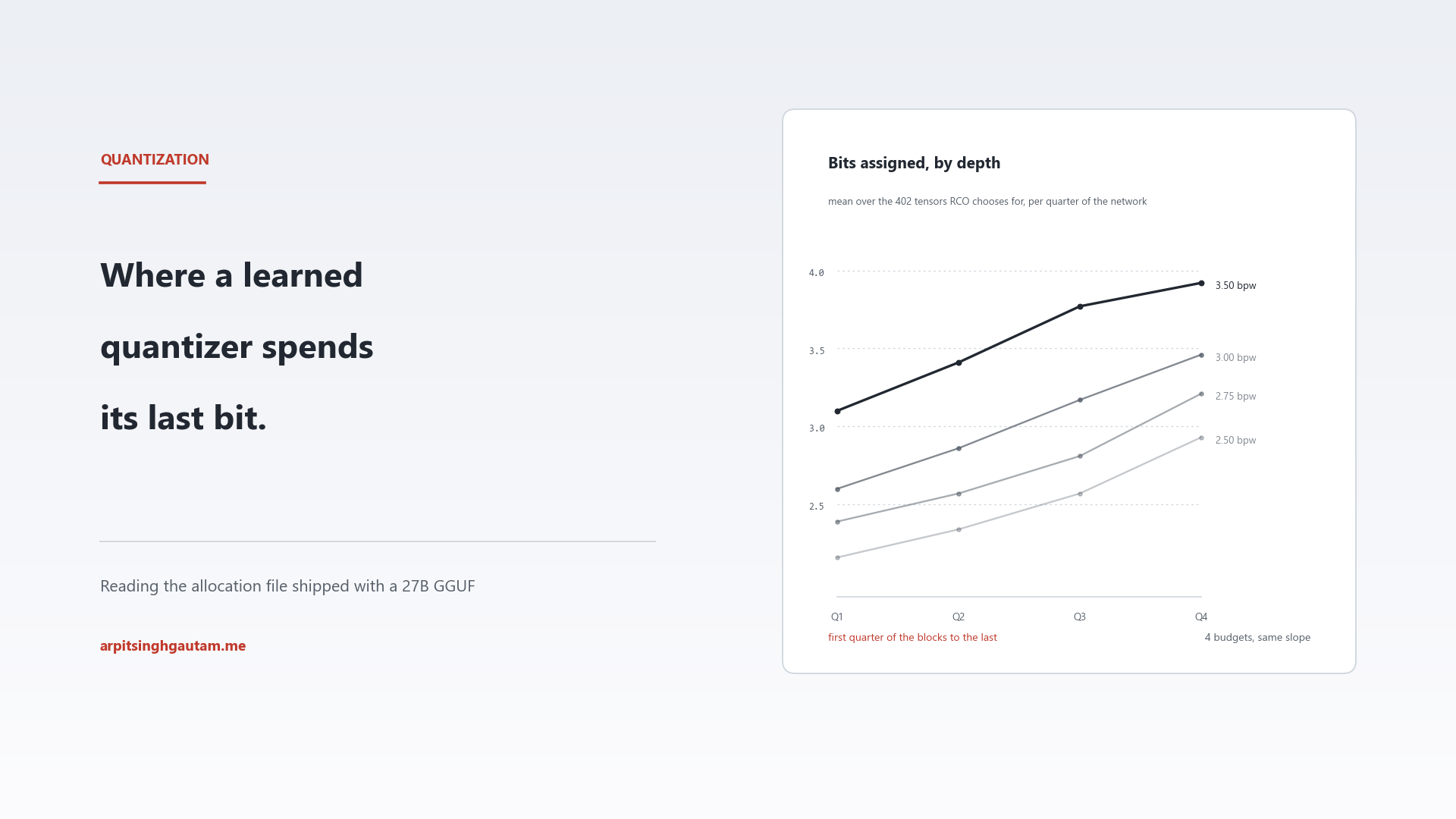
ISTA-DASLab shipped GGUF quantizations of Qwen3.8-27B together with the per-tensor allocation its optimizer chose, which almost nobody does. Parsing those files shows the deepest quarter of the network gets 0.8 more bits than the first, the embedding is crushed to 1.75 bits while the output head is protected, and the SSM gates are never quantized at all. Meanwhile the task-lossless headline rests on one question out of 198.
Sep 2026 · 11 min read · Quantization · Efficiency · Benchmarks
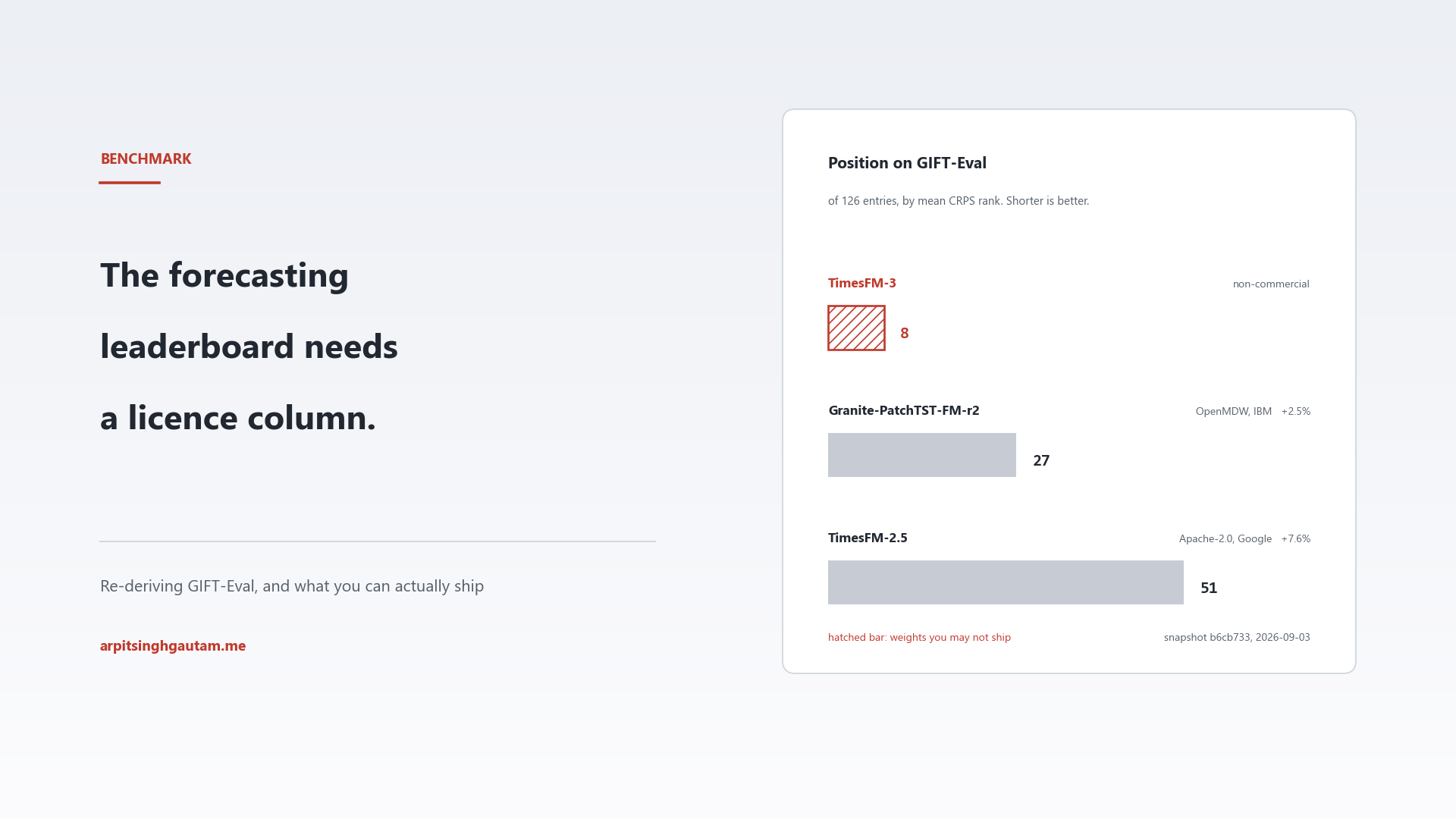
TimesFM-3 is rank #1 on GIFT-Eval among pre-trained foundation models, the claim is precise and correct, and the weights are non-commercial. I re-derived the board from its own published results and joined the one column it does not have. Obeying the licence costs 2.5% by changing vendor and 7.6% by staying with Google, plus two silent data-quality defects found along the way.
Sep 2026 · 12 min read · Benchmarks · Evaluation · Time Series
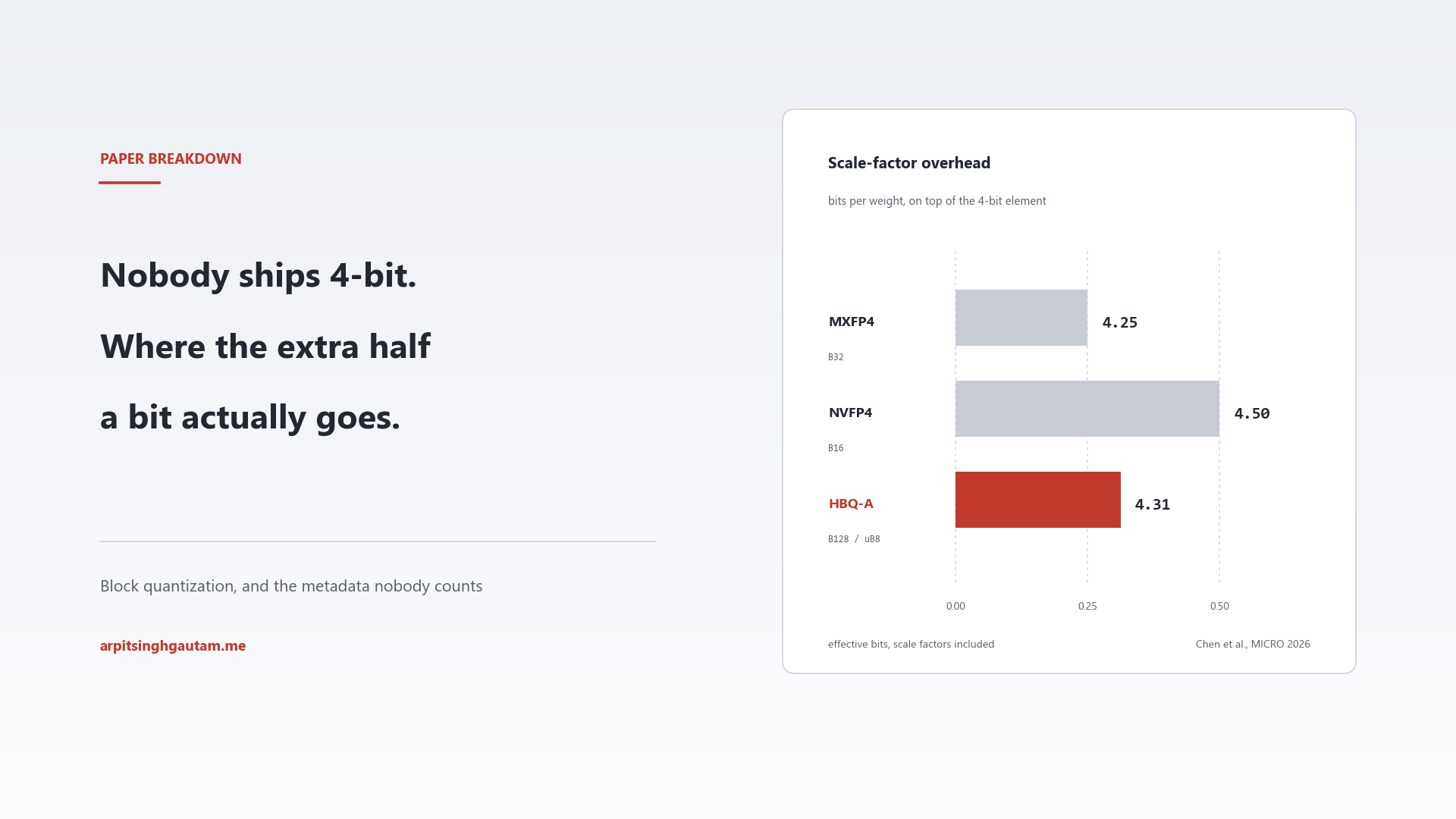
MXFP4 is 4.25 bits and NVFP4 is 4.5. Put the scale factors on the same axis as the element and the whole block-quantization design space becomes one question: at what granularity do you spend your metadata budget? A close reading of HBQ (MICRO 2026), plus the exchange rate between its two scaling levels.
Sep 2026 · 12 min read · Quantization · Hardware · Inference
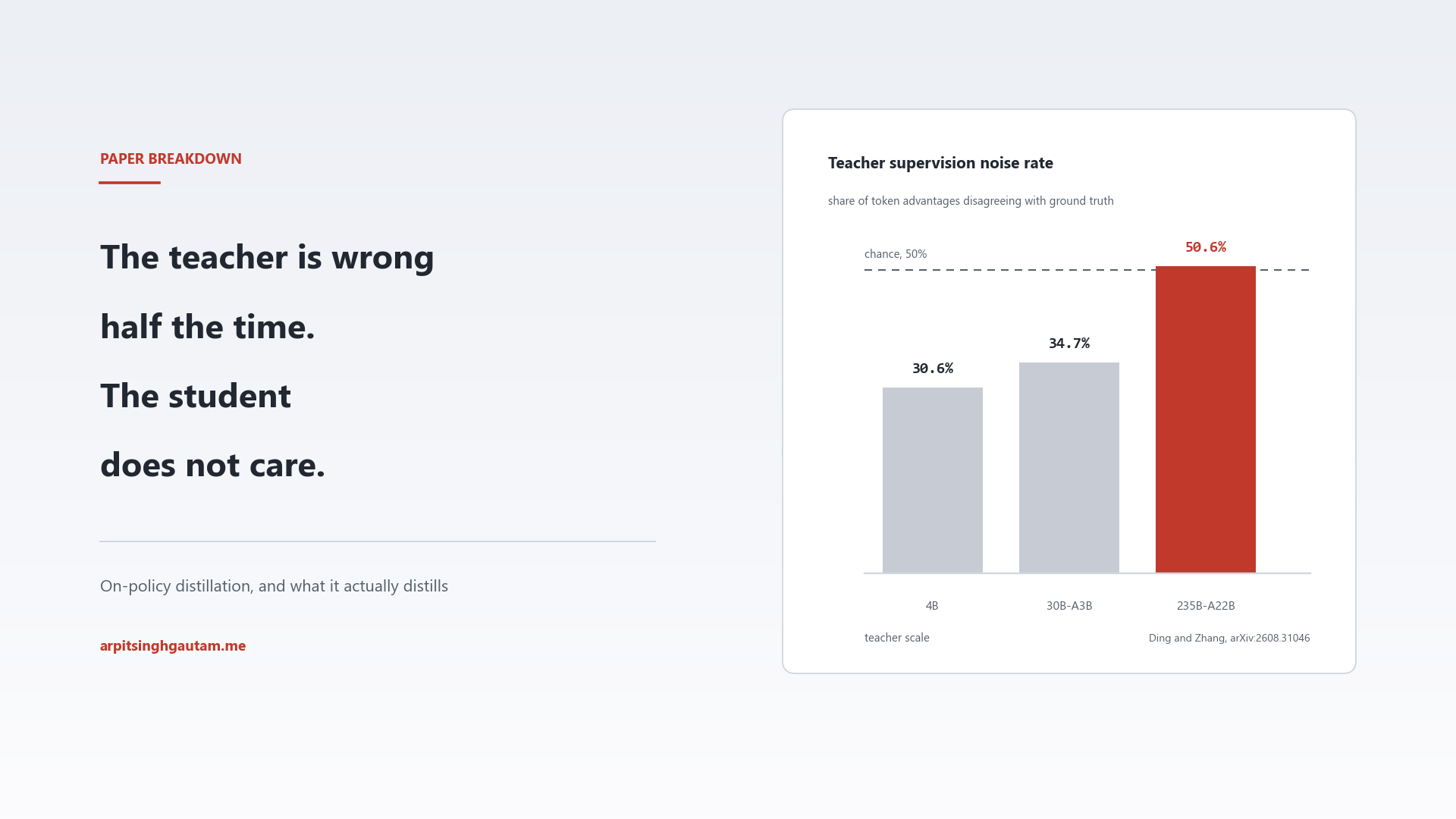
A close reading of arXiv:2608.31046. Teacher supervision disagrees with ground truth 50.6% of the time at 235B and the student converges anyway. Why the advantage measures confidence rather than correctness, what is left when you delete the teacher, and the comparison that calibrates the headline number.
Sep 2026 · 11 min read · Distillation · RL · Post-Training
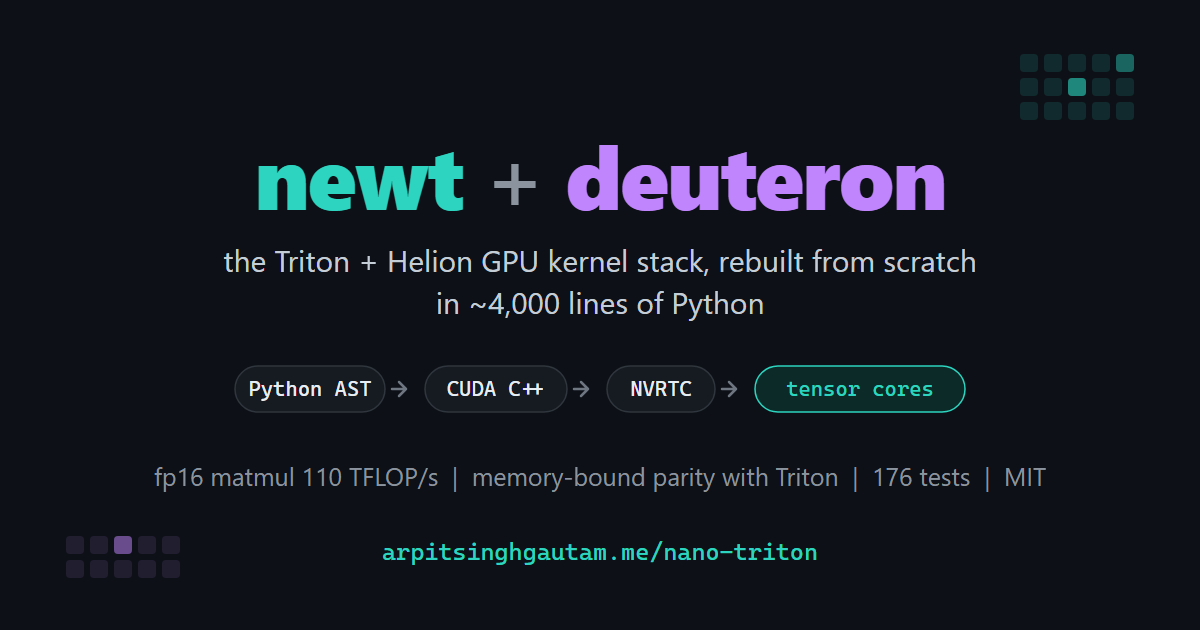
A working Triton and a working Helion in ~4,000 lines of Python: NVRTC instead of MLIR, one register-layout rule that buys most of the performance, raw tensor-core PTX, and an autotuner that cannot ship a wrong kernel. Memory-bandwidth parity with Triton and 76 to 83% of its sustained fp16 matmul throughput. On PyPI.
Jul 2026 · 15 min read · GPU Kernels · Compilers · CUDA
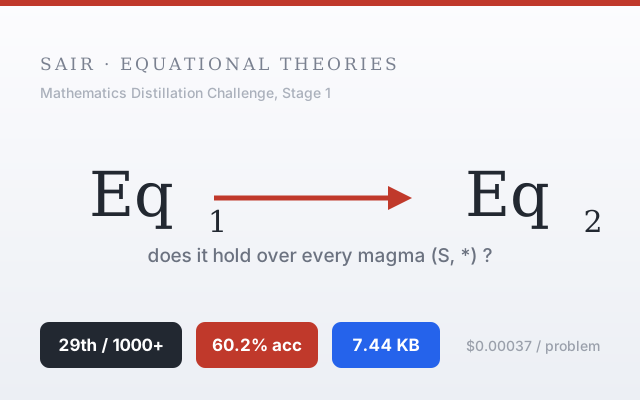
How I placed 29th of 1000+ in the SAIR Foundation (Terence Tao, Damek Davis) Mathematics Distillation Challenge: a two-phase decision procedure for equational implication over magmas, on the accuracy-cost-size frontier.
2026 · 9 min read · Distillation · LLM Reasoning · Math
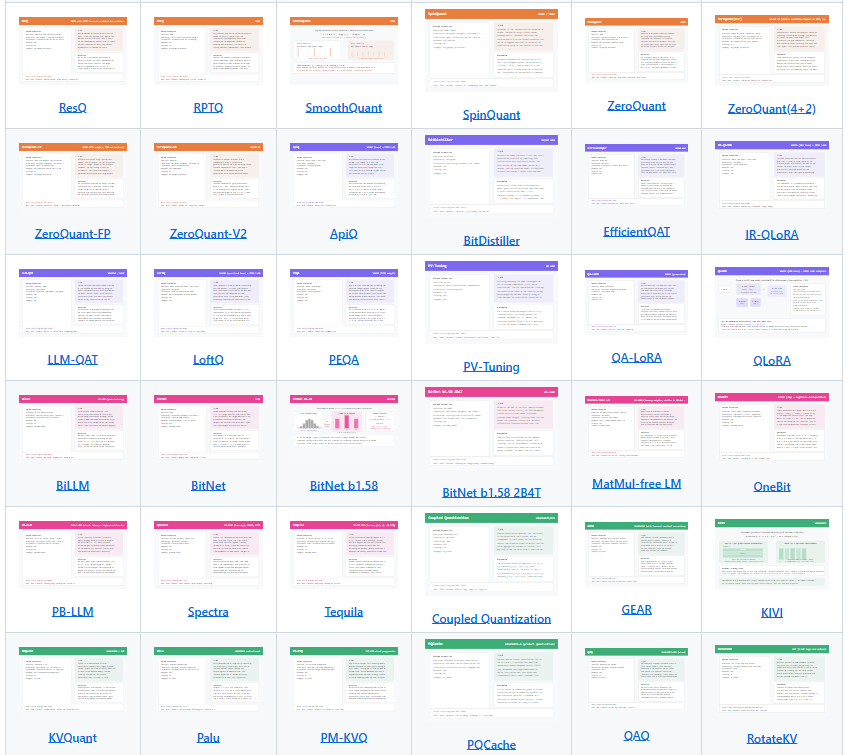
INT4, INT8, GPTQ, AWQ, QLoRA - a practical breakdown of the quantization methods reshaping how we deploy LLMs, plus the story behind building an interactive gallery to explore them.
Apr 2026 · 8 min read · LLMs · Quantization · Systems
How Google compresses the KV cache by 6× with zero accuracy loss - random rotation, per-element quantization, and QJL residual correction explained. Presented at ICLR 2026.
2026 · 10 min read · Quantization · KV Cache · LLM Inference
Program synthesis, test-time training, fluid intelligence - what makes ARC-AGI the hardest benchmark in AI, and my early experiments competing in it with a random agent baseline.
2026 · 7 min read · AGI · Reasoning · Benchmarks
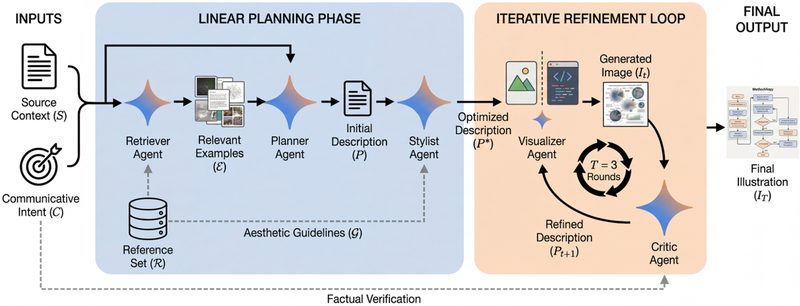
Google's two new research agents - one for automated figure generation, one for AI-assisted peer review. What they get right, what they miss, and why novelty evaluation is still a hard problem.
2026 · 8 min read · AI Tools · Research · Agents
More posts coming soon. Follow @Asg_Wolverine for updates.